Saturday, February 28, 2015

Filing a false tax return comes with big penalties

Filing a false tax return comes with big penalties

dirty dozen irs scam 8

Allow a tax preparer to understate your income on a 1099 or W-2 in order to lower your tax bill or get you a bigger refund, and you could be in big trouble if the IRS finds out.

"The mere suggestion of falsifying documents to reduce tax bills or inflate tax refunds is a huge red flag when using a tax preparer," IRS Commissioner John Koskinen said in a statement.

Related: IRS warns of shady tax preparers

Or an unscrupulous preparer may ask you to sign a statement that rebuts the income and tax information reported to the IRS by your employer or another third-party.
Bottom line: Never let anyone talk you into claiming deductions or credits to which you're not entitled. And never let others file a false return on your behalf.

The act of filing a false return can lead to a $5,000 penalty, the IRS said. And your participation in a scam of this kind may also lead to interest and penalties on any back taxes you might owe -- and possibly criminal prosecution. 

8 tax audit red flags


Budget cuts at the IRS may mean fewer audits this year. But that doesn't mean everyone will get away scot-free.
While chances are low that your return will be targeted by the IRS, why put yourself at risk at all?
Here are 8 relatively easy ways to steer clear of an audit:
1. Report all of your income. Wages from most jobs are reported on W-2 forms, while any interest, dividends and capital gains you made are reported on 1099s, as is income earned by independent contractors or freelancers.
Those forms are sent to both you and the IRS. So be sure to include all information from them on your federal tax return.
Here's why: The agency uses an automated form-matching program to flag discrepancies between what you report and what the IRS has on file, according to the National Association of Enrolled Agents, who are tax preparers authorized to represent clients in an audit.
Any discrepancies will trigger a correspondence audit. Basically, the IRS will send you a letter telling you how much more you owe based on the income you failed to report.
It's up to you whether to just pay the bill or challenge it if you think the IRS didn't calculate it correctly.
2. Run a small business? Prove it. Very few people make a profit when they first start their own business. The IRS understands this... up to a point.
Report losses for three or more years and the agency will start to suspect your business is more of a hobby than a venture aimed at turning a profit, said former IRS tax attorney Garrett Gregory of Addison, Texas.
Such "hobby loss" cases may trigger a field audit, which is in-person and more onerous than a correspondence audit.
Related: Filing a false tax return comes with big penalties
To prove you have a real business, be sure to keep records of your business expenses and document how much time you spend on the business and what you do with it.
You want to prove that you "breathed it, ate it, slept it, drank it," Gregory said.
3. If anything seems weird, explain it. The IRS has its tentacles up for unreported income, so explaining anything that looks questionable may dissuade the agency from pursuing an audit.
For example, if your net income is too low to live on given such factors as where you live and your family size, include a disclosure statement detailing how you supported yourself, including any savings, loans or credit cards that you used to pay the bills, the NAEA recommends.
4. Watch the home office deductions. Typically your office is in one place -- either in a rental space or in your home. So don't report a deduction for both. (If you legitimately have offices in both places, explain why in a disclosure statement.)
If your rental expense is for a business storage unit or equipment, the NAEA recommends labeling that cost as a "storage rental" or "equipment rental."
5. Report the sale of mutual funds: If you sold a mutual fund that you bought before 2011 outside of a tax-advantaged retirement account and you reinvested the money in another mutual fund, you must report it on your federal return, said enrolled agent Stephen DeFilippis of Wheaton, Ill.
If you don't, the IRS will assume the total proceeds from the sale are all taxable gains. And it will send you a letter that recomputes your tax bill accordingly.
In that case, you'd need to go back and prove to the IRS that only a portion of the proceeds represent your capital gains and the rest was your cost basis (i.e.; the amount you originally invested in the fund). Or, if you sold the fund at a loss, that you don't owe any tax on the sale.
6. Come clean about any money overseas: U.S. taxpayers who have bank or investment accounts abroad must report any income they earned on those accounts to the IRS.
While that's always been the case, under the relatively new Foreign Account Tax Compliance Act (FATCA) your foreign financial institution may soon start to report that information to the IRS like any other bank or brokerage would in the United States.
If you've had the account for years, never reported it, and the IRS finds out about it from your foreign bank or investment firm, you could owe some serious penalties in addition to back taxes if the account has generated taxable income, Gregory noted.
Related: IRS will do fewer tax audits this year
To pre-empt such expensive surprises, the IRS has sponsored an offshore voluntary disclosure program that lets people come clean on their own volition and by doing so, reduce any penalties they may owe.
7. Report the sale of your home: When you sell your home, the title company will send you and the IRS a 1099-S form, recording the proceeds from the sale.
Even if all your capital gains on the sale are tax-exempt (because they didn't exceed $250,000 if you're single or $500,000 if you're married), DeFilippis recommends you report information from that 1099-S on your return anyway.
His reason: the 1099-S is part of the IRS form-matching program. Not reporting it may generate a correspondence audit.
8. Be smart about mortgage interest: When you own a home with your spouse, your lender will send you and the IRS a Form 1098, which records how much mortgage interest you paid during the year.
But sometimes the form only includes the name and Social Security number of one spouse, DeFilipis said. Should that person die, and the surviving partner tries to claim the mortgage interest deduction, that may trigger a correspondence audit.
So have the lender change the name and Social Security number on the 1098 before filing. Or, if there's not time for that before April 15, file for an extension and submit your return when you have an amended 1098 in hand.
View this article on CNNMoney


More From CNNMoney.com

Transforming My Life Through Food at Hu Kitchen

Transforming My Life Through Food at Hu Kitchen

Sara Bliss
Transforming My Life Through Food at Hu Kitchen
Jordan Brown: I always considered myself healthy. I ate lots of whole grains, no junk food, and I exercised regularly. Then I spent a particularly rough week in Vegas at a real estate conference. I felt awful, and just happened to pick up The Ultra Mind Solution by Dr. Mark Hyman. It is essentially about healing through food and I was fascinated. I decided to make one change from that book, which was cutting out gluten.  Within 3 days, a persistent skin condition that I had—and could never get rid of—vanished.  At 28, I finally understood the power of food.

I became obsessed with really understanding what I was putting in my body. I started reading more and more and tried everything, going vegan, becoming vegetarian, cutting carbs. I came across a book called Primal Blueprint by Mark Sisson about eliminating grains, legumes and most dairy. Nothing had ever quite curbed the systemic inflammation of my body and now I felt so much better than I ever had.

The problem, of course, was eating out. At restaurants, the ingredients and quality just weren’t what I wanted. I wasn’t satisfied with the oils they were cooking in or quality of the food. To eat the healthiest food I had to cook at home, so my sister and I became obsessed with the ingredients and details that really matter when you eat out. We wanted to create a restaurant where there isn’t any crap, where we cooked in the right oils, used the best sweeteners and emusifiers, with 100% grassfed beef, wild fish, and organic poultry. The concept behind Hu Kitchen became everything that we would want to eat without any of the junk. We vowed not to use cane sugar, highly processed salt, chemical anti-caking agents, or poor quality meat and dairy.
image

At Hu Kitchen, we created a place where food is made in a way that makes people feel better after they eat. The example I always give is that I used to love bacon, egg, and cheese sandwiches, but an hour later I would feel awful. So we do a sausage, egg, and kale with a vegetable based bread and 100% grass fed beef. It fills you up without spiking your blood sugar; it’s hearty and healthy.

Hu Kitchen is a place you can eat every meal, snack, and juice. We have a strong culinary team. One of our chefs lost 60 pounds in three months from eating this way. It’s truly life-changing.
The whole concept of thriving versus surviving is one that really speaks to me, and I have found through all of this that one of the best ways to thrive is through food. Everything in my life has changed dramatically by changing how I ate. I can’t believe how good I feel. And to be able to help provide that change for other people is something I could not be more proud of.

—JORDAN BROWN AS TOLD TO SARA BLISS

How Eating Clean Can Change Your Skin

How Eating Clean Can Change Your Skin

How Eating Clean Can Change Your Skin
Photo: Henry Leutwyler
Maybe you skipped out on making any resolutions in January, but with February kicking off, it doesn’t mean it’s too late. You can still make this the year of eating clean and indulging wisely. What is clean eating? It isn’t about washing all the pesticides off your produce, if that’s what you were thinking. It’s about choosing all natural,whole foods while incorporating complex carbohydrates, fresh fruits, lean protein, vegetables and healthy fats.

And what does this have to do with beauty? Because our skin is our largest organ and its beauty on the surface is a reflection of what we’re feeding it on the inside. Ever notice how when after a weekend of overdoing it with alcohol and sugar, your face breaks out? Studies have shown that those inflammatory foods mentioned above can cause internal imbalances, which are mirrored on our skin, usually in the form of acne. And that’s one aspect of youth we’d all rather leave in the past.

You might be thinking, “What the heck am I supposed to eat?” Luckily there are tons of healthy foods that are easy to prepare and taste delicious; you might just need to explore a few unfamiliar aisles in the grocery store. Plus, inspiring resources are endless; check out #eatclean on Instagram and you’ll find thousands of meals that will actually get you excited about quinoa; or start right here with our own Clean Food Dirty City quick and tasty recipes.
You’ll want to eat 5-6 meals and snacks throughout the day, preferably cooked at home and served in controlled portions. Meals should be high in fiber and, not to be a buzzkill, free of potentially inflammatory foods including dairy, sugar, alcohol, gluten, most red meat, caffeine, processed foods, fried foods, artificial colors and sweeteners.

Creating healthy eating habits gives you the space to enjoy your favorite foods, without feeling deprived, while teaching you to focus on the good foods you should be eating most of the time. Eventually this becomes second nature and you aren’t even thinking about the percentage of healthy food versus those foods that you crave, which might not be so healthy; you’re intuitively eating foods from every color of the rainbow, and those that don’t come from a bag, because they make you feel that much better. 

Keri Glassman, founder of Nutriouslife, is a big fan of eating from a place of empowerment rather than emotions. “I like to encourage the attitude of listening to your body and indulging when you really have a true craving or just simply want something decadent. It’s not ‘I can’t eat the chocolate cake,’ it’s ‘I can have the blueberries.’ When you do this, you don’t want to indulge as much and when you do just have to have something it’s much easier to have a small slice [of cake] and move on.”

Being mindful of eating to fuel your body rather than your emotions is key, but so is listening to your body. I’ve got a resolution for you: each week drop one unhealthy food group on the list until you’re eventually eating clean intuitively. In just a few months you’ll reconnect with your body in a way that you’ll know when you’re truly craving that chocolate cake, or you’re just letting it taunt you out of habit.

What Do Fried Foods Do to Your Skin?

What Do Fried Foods Do to Your Skin?
Good skin or fried chicken? You might have to choose one or the other. (Photo: Chris Craymer/Trunk Archive)

We’ve all heard the warnings that fried foods cause heart disease, high cholesterol, and obesity, did you ever stop to think what all those greasy treats are doing to your face? While it may be hard to give up your favorite deep fried goodies, you may have to if you’re seeking clear, radiant skin. A dermatologist and a nutritionist weigh in on the age-old skin legend.
“The skin really needs fat to build, and we rely on outside sources to get those good fats,” explains Dr. Macrene Alexiades-Armenakas, MD, PhD. “The best fats, such as Omegas 3 and 6, tend to come from raw fats, not fried.” Think fish, avocado, pumpkin seeds, and flax seeds. “Frying food results in fully oxidized, saturated fat, which is the worst kind you can take into your body,” says Macrene. “It could impede the ideal structure of the skin.” While she believes that fried foods can keep you from the glowing skin you desire, she feels carbs and dairy might actually be worse for your complexion. “In my experience, the diet factors with the most impact on acne-prone patients are dairy—because of the hormones—and high amounts of carbs.”

Other experts point the finger at fried foods for a host of skin problems. “Consistent consumption of fried foods causes damage to the cellular structure of the dermis and epidermis, and this leads to sallow, aged skin and more cystic acne,” says Dana James, MS.,CNS, nutritionist and founder of Food Coach NYC. “Since it prevents the skin from retaining essential moisture, it becomes dehydrated and lined.” Toxins won’t be cleared as effectively either. Hello, breakouts.

Ultimately, it’s important to pay attention to what you’re putting into your body, because everything you eat affects your skin. “Your grandmother wasn’t completely, wrong when she told you fatty food will cause breakouts, but she wasn’t completely right either,” says Brooke Alpert, MS., RD., CDN, chief nutrition advisor for Selvera. She agrees that natural, healthy fats are great for your skin and complexion, and cautions against frying. “The processed plant oils commonly used in frying are going to wreck your skin,” says Alpert. “They oxidize at high frying temperatures, which can cause everything from heart disease to poor circulation. Since proper circulation allows for necessary nutrients to get to your skin, anything that impedes it will result in premature aging and a poor complexion.”

Sallow skin and acne could very well just be a warning to what’s happening underneath, but eventually no amount of skin cream can counteract what’s happening on the inside with a dangerous, fatty diet. Limiting exposure to battered, fried treats can do more than help you save face; it could inevitably save your life. 

Friday, February 27, 2015

Radiant heating comes of age -- after millennia

Bob Vila

Radiant Heating Technology


While the origins of radiant floor heating stretch way back into the mists of history, the technology has come of age only in recent years. Today, it works as well as any other traditional system, if not better, and operates at least 25 percent more efficiently than forced-air systems, the most ubiquitous type of heating in the United States. Increasing numbers of consumers are choosing radiant heating, not only for the energy savings it provides, but also for its indoor air quality benefits and its ability to free homeowners from the tyranny of radiators, baseboards, and vents. That said, many wonder why radiant heating isn't in more American homes, especially considering its popularity abroad (in Europe and Asia, 40 and 80 percent of homes, respectively, are heated by a radiant system). Well, though it may now be a viable product, it didn't start out that way.

The very first radiant heating systems emerged in the Roman Empire. In the wealthiest citizens' homes, the walls and floors were buttressed by slim chambers called hypocausts. Fires around the building fed heat into these hypocausts, which in turn heated the interior spaces of the home. Around the same time, on the other side of the globe, the Korean ondol system heated homes by means of cooking fires that transmitted heat from the kitchen to a series of strategically positioned stones. These stones would absorb the heat and slowly radiate it outward. Though primitive compared with the finely tuned, zero-maintenance radiant-heating products available today, the fact that the basic technology has been around for so long speaks to the simple wisdom of its design.
[Want to remodel your home? Click to find a home contractor now.]

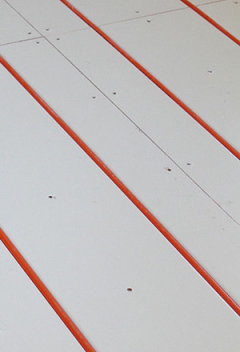
Radiant Heating Technology - Panel Detail
In the United States, it was none other than the distinguished architect Frank Lloyd Wright who first introduced the concept of radiant heating to countless Americans. Of course, Wright was ahead of his time in more ways than one, so it was not until decades after his death that radiant heat finally came into focus.

When environmental concerns came to the fore in the 1970s and 1980s, a diverse group of professionals and amateurs began testing out various nontraditional modes of building. In these experimental efforts, the principles of radiant heating were often aligned with solar power. A typical setup would put a concrete floor, painted a dark color, beneath a sunny south-facing window. Throughout the day, the sun would heat the concrete, then as night fell and temperatures dropped, the concrete would radiate heat back into the home. That worked fine for supplemental heat, but it could not heat a whole house through the winter season.

In the next phase of development, radiant heating took a big step toward becoming its own entity, an active system capable of providing heat with or without help from the sun. Ingeniously, hydronic tubes were set into the concrete flooring. Water heated by the boiler could be pumped through the tubes, heating the concrete in the absence of sun. The only problem now was the concrete. Whereas its thermal mass had proved an asset before, it was now making the system sluggish. Not only would the concrete take too long to heat up, but it would also continue to radiate for several hours after the thermostat had been turned down or off.
[Want to remodel your home? Click to find a home contractor now.]

The answer, Warmboard found, was to combine hydronic tubing with lightweight, highly conductive aluminum. Compared with concrete, aluminum is a staggering 232 times more conductive. So when heated water travels through the hydronic tubing within aluminum panels, the metal swiftly transfers the heat to the home. The panels conduct heat so effectively that they can be used beneath any type of flooring, be it tile, hardwood, or even thick-pile carpeting.

Broadly similar products exist on the market, but Warmboard stands alone in terms of efficiency and conductivity. Put simply, Warmboard requires the least amount of energy of any radiant system to maintain a comfortable temperature in the home. It’s estimated that Warmboard can hit the target temperature with water that's 30 degrees cooler than a competing system would require to achieve comparable results. This efficiency means that your furnace doesn't need to work as hard, and you save an additional 10 to 20 percent on energy costs—above and beyond what you're already saving by choosing radiant heat over a traditional system.

It may have taken a few thousand years to get right, but radiant heating has finally arrived.


This post has been brought to you by Warmboard. Its facts and opinions are those of BobVila.com.

The Secret to Resolving Credit Card Debt

February 26, 2015

Here’s what credit card companies don’t want you to know...and what thousands of consumers are quickly learning about paying off their debt:

If you owe more than $25,000 in credit card debt, this proven debt relief program, offered through companies like Freedom Debt Relief,1 may reduce the amount you owe. Consumers could resolve their debts with absolutely no loan required and pay it off in as little as 24 - 48 months*. If you’ve struggled to pay your credit card debt, act now before your debt balloons further.

You Can Pay Off Debt Without a Loan

The first choice many consumers think of is to take out a debt consolidation loan. For those with good credit, this is an attractive option but there’s a catch:

Lenders are only happy to give out loans to people who are credit worthy and can show the ability to
make the loan payments. Unfortunately, people with poor or fair credit often do not qualify for this option.

This is bad news for the millions who are faced with high interest and unpayable debt. Their debt only continues to accumulate. Fortunately, there is a solution. This debt relief option is available to all qualified individuals regardless of credit. With help from the right debt relief company, you could design a payment plan you can actually afford.

Credit Card Companies Have a Lot to Lose
Credit card companies profit significantly off of struggling consumers who are only making the minimum payments and can’t afford to pay off their debt faster. So why would the credit card companies want you to know about a debt relief program?

You guessed it. They DON'T. They are perfectly happy letting the interest on your debt pile up and make a lot more money. The problem for consumers is that they might think the bank’s minimum payment is the only way. But, you should know there could be BETTER alternatives! So if you’re struggling, here’s what you could expect with a debt relief program:
  • Resolve your debt for less than what you owe
  • Get a payment plan you could actually afford
  • Resolve your debt fast in 24-48 months*
    Who Should I Work With?

    Freedom Debt Relief is one of the most reputable companies in the industry with years of proven experience. To date, Freedom Debt Relief has resolved the most consumer debt (over $3 billion dollars)! They've helped thousands of ordinary Americans regain control of their finances.
    To find out if you qualify, simply answer a few questions about your debt and financial circumstances. It only takes a few minutes to get a free, no obligation quote online. You'll also have the opportunity to speak with a certified debt consultant to review your specific situation and learn more about your options. Stop overpaying on your debt and find out how you can finally tackle it for good.

    Select Your State:
    Created with Raphaël 2.0.0
    VTNHMARICTNJDEMDDCHIAKCANVORWAIDMTWYUTAZCONMTXOKKSNESDNDMNIAWIILMOARLAMSALTNKYINMIOHPANYMEWVVANCSCGAFL